From the Apothecary Shelf to the Cocktail Glass: The Unlikely Ascent of American Bitters
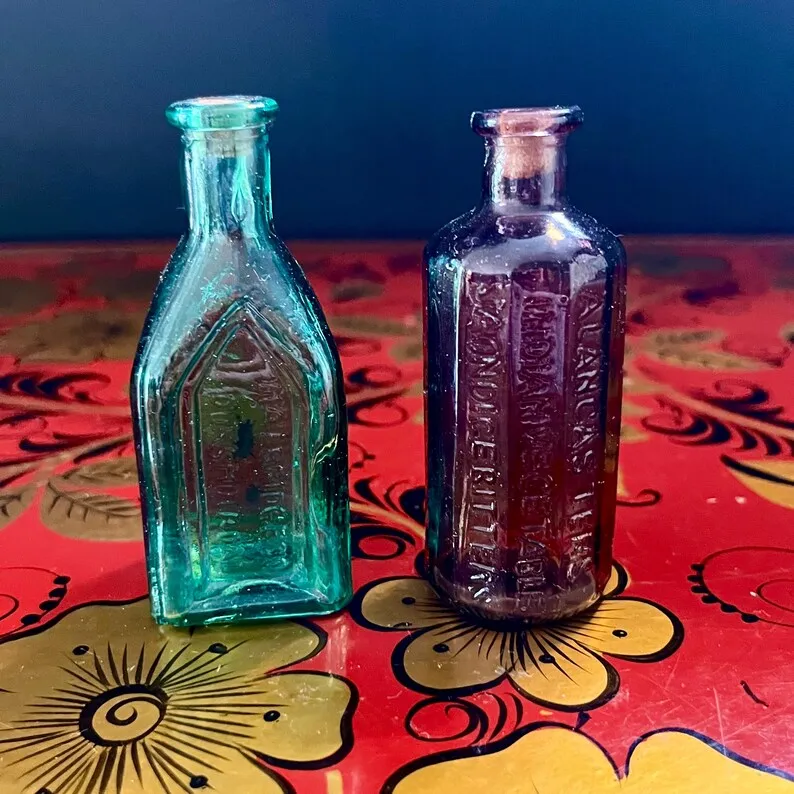
Photo: vintage apothecary bitters bottles 19th century bar antique, via i.etsystatic.com
A Cure That Needed No Illness
In the middle decades of the nineteenth century, the American patent medicine trade was a booming, largely unregulated enterprise built on two reliable pillars: the public's chronic anxiety about its own health, and the extraordinary willingness of traveling salesmen to promise relief from nearly everything. Bitters occupied a peculiar and profitable niche within this commerce. Technically a medicinal preparation — and therefore exempt from the liquor taxes that bedeviled ordinary distillers — they were, in practical terms, spirits steeped with roots, barks, herbs, and dried citrus peel, then bottled and dispatched to pharmacies, general stores, and hotel lobbies across the expanding republic.
The legal distinction between a medicinal bitters and a drinkable spirit was, to put it charitably, flexible. Angostura, produced in Venezuela and imported in quantities that grew steadily through the century, was classified as a digestive tonic. So was Boker's, an aromatic preparation that became the preferred bitters of serious American bartenders by the 1860s. Peychaud's, formulated in New Orleans by the apothecary Antoine Amédée Peychaud sometime in the 1830s, was dispensed in a small egg cup — the coquetier — to customers who arrived at his shop on Royal Street seeking both a remedy and, one suspects, something rather more pleasurable than medicine.
The therapeutic framing was not entirely dishonest. Gentian root, wormwood, cinchona bark, and other bittering agents do stimulate digestive secretions. The aromatic compounds in cloves, cardamom, and dried orange peel have genuine carminative properties. But the alcohol content of these preparations — often running between 35 and 45 percent — did the heavier lifting, and everyone involved understood as much. The apothecary sold relief. The customer drank it with gratitude and returned for more.
The Bartender's Quiet Adoption
What is remarkable about the transition of bitters from medicine cabinet to bar rail is how unremarkable it appeared at the time. By the 1860s, when Jerry Thomas published his landmark Bar-Tender's Guide, bitters were simply assumed to be a component of serious cocktail-making. Thomas's definition of a cocktail — spirits, sugar, water, and bitters — treated them not as an optional flourish but as a structural element, the ingredient that distinguished a cocktail from a mere sling or toddy.
This was no accident of taxonomy. The aromatic complexity that bittering agents contributed to a drink solved a real problem for the bartenders of the era. American whiskeys of the mid-nineteenth century were frequently rough, young, and inconsistent. Gin varied enormously in quality. Bitters provided a unifying layer of flavor — a kind of botanical scaffolding — that could bring cohesion to a glass of spirits that might otherwise fight itself. They also added what we would now call length, extending the finish of a drink and giving the palate something to hold onto after the sweetness faded.
Boker's Bitters, produced in New York by Johann Gottlieb Boker, became the gold standard for this purpose. Its formula — built around cassia, cardamom, and a proprietary blend of roots — appeared in recipe after recipe through the 1870s and 1880s. Its disappearance around the turn of the century, likely a casualty of the consolidation and adulteration that plagued many patent preparations of the era, left a gap that bartenders of the period felt acutely. When Prohibition arrived in 1920 and swept away most of what remained of the pre-war bitters trade, the loss was compounded to the point of near-erasure.
The Brands That Survived and the Knowledge That Didn't
Angostura and Peychaud's endured Prohibition largely because they were classified as non-potable — a designation that required some imaginative interpretation given their alcohol content, but one that regulators proved willing to extend. Orange bitters, which had been ubiquitous in the pre-Prohibition bar, did not fare as well. The major commercial producers either shuttered or reformulated into products barely recognizable to anyone trained on the originals. For decades after Repeal, the orange bitters bottle that once sat beside the Angostura on every respectable back bar was simply absent, and the recipes that called for it were quietly misread, omitted, or rewritten.
This was not merely a matter of missing ingredients. It represented a rupture in transmitted knowledge — the kind of gap that only becomes visible when someone attempts to reconstruct a drink from a pre-Prohibition recipe and discovers that the result, made with modern substitutes, tastes fundamentally different from what the original formulation would have produced. The aromatic profile of nineteenth-century bitters was not interchangeable. Boker's was not Angostura. Orange bitters were not aromatic bitters. These were distinct instruments, and the music changed when they disappeared.
The Revival and What It Reveals
The contemporary resurgence of bitters — now numbering in the hundreds of commercially available expressions, ranging from the scholarly recreations of Boker's and Regans' Orange Bitters No. 6 to the more adventurous productions flavored with black walnut, celery, or smoked chili — has been one of the more intellectually honest developments in the modern American bar. It reflects a genuine reckoning with what was lost and a willingness to do the work of recovery.
The best practitioners of this revival have approached the subject with something approaching archival rigor. Fee Brothers, operating out of Rochester, New York since the 1860s, never entirely abandoned the category and provided continuity when others did not. The Bitter Truth, Bittermens, and a growing roster of small producers have since expanded the palette considerably, drawing on historical formulations while acknowledging that modern bartenders work in a different sensory context than their predecessors.
What the revival has also clarified is the degree to which bitters function as a seasoning rather than a flavoring agent in the conventional sense. A few dashes of Angostura in an Old Fashioned do not make the drink taste of cloves and gentian; they make it taste more fully of itself, the way a pinch of salt makes a sauce taste more completely like what it already is. This is the property that nineteenth-century bartenders understood intuitively and that two generations of post-Prohibition drinkers largely forgot — that bitters are not a garnish or an affectation but a mechanism of integration, a means by which disparate elements in a glass are persuaded to cohere.
The Small Bottle with the Long Memory
There is something instructive in the trajectory of bitters — from the apothecary's shelf, through the golden age of American bartending, into the near-oblivion of the mid-twentieth century, and back again to the contemporary bar — that speaks to a broader truth about the history of American drinking. The ingredients that endure are rarely those that shout. They are the ones that do quiet, essential work, whose absence is felt more keenly than their presence is celebrated.
The patent medicine men who first bottled these preparations were not, for the most part, thinking about cocktails. They were thinking about dyspepsia and profit. But they produced something that outlasted their intentions by a considerable margin, something that a bartender in New Orleans in 1840 and a bartender in Brooklyn in 2024 would both recognize as indispensable. That continuity, fragile as it proved to be, is worth honoring — one precisely measured dash at a time.