Wrong Bitters, Right Drink: Seven Cocktails That History Says Were Born by Accident
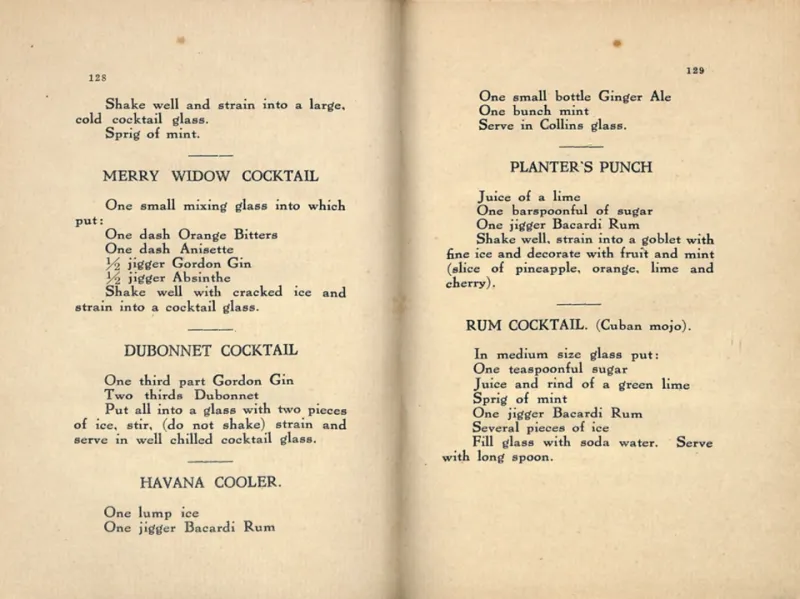
Photo: Blanche Zacharie de Baralt, Public domain, via Wikimedia Commons
Bartenders love a tidy origin story. The drink appears, fully formed, from the brow of some genius mixing man, and the legend is laminated onto the menu. The historical record is less cooperative. Again and again, when you dig into the primary sources — the old manuals, the newspaper columns, the correspondence of the people who were actually there — you find that the famous drink was not designed at all. It stumbled into existence. A delivery error, a wartime shortage, a barkeeper improvising with what was on the shelf. Here are seven drinks that owe their existence to accident, more or less.
1. The Manhattan
The popular legend — a party at the Manhattan Club, a Lady Randolph Churchill who was almost certainly not there, being in England and heavily pregnant — collapses under the slightest scrutiny. What we actually have is a drink that surfaces in New York drinking culture in the early 1880s with no credited author. The likeliest truth is less glamorous: the Manhattan is what happened when bartenders, already mixing whiskey-and-vermouth drinks, began experimenting with the new French vermouths and Italian bitters arriving on the docks. Nobody invented it. It accreted.
2. The Sazerac
New Orleans will tell you Antoine Peychaud created it, and Peychaud's bitters are certainly in the glass. But the drink as we know it — whiskey, bitters, sugar, absinthe-rinsed glass — is the result of a substitution. The original called for cognac; when phylloxera devastated French vineyards in the 1870s and 1880s, making cognac scarce and expensive, New Orleans barkeepers quietly swapped in rye whiskey. The Sazerac we drink today is a grape shortage wearing a carnival mask.
3. The Old Fashioned
This one is an accident of a different kind: an accident of nostalgia. By the 1880s, the cocktail had evolved — newfangled ingredients, fancy garnishes, the works. Older drinkers, grumbling, began asking for their drink "the old-fashioned way": spirits, sugar, bitters, water. The name was not an invention. It was a complaint that stuck.
4. The Margarita's Many Accidents
The Margarita claims more origin stories than any drink in America, and the honest answer is that several of them may be true simultaneously. One of the most credible involves a simple substitution error at Rancho La Gloria near Tijuana in the late 1930s, where a bartender mixed tequila into a drink meant to follow the standard formula of an Acapulco-style daisy — "margarita" in Spanish. The daisy family, after all, is spirit, citrus, and orange liqueur. Substitute tequila for brandy and you have, quite literally, a tequila daisy. The mistake was grammatical, perhaps. But it was a mistake.
5. The Bloody Mary
Harry's New York Bar in Paris claims it; the St. Regis in New York claims it harder. What seems most likely is that the drink began as a simple tomato juice and vodka mixture — credited to bartender Fernand Petiot at Harry's — and acquired its pepper, its Worcestershire, its Tabasco, and its celery through decades of improvisation. Each addition was somebody's experiment. The drink is less an invention than an accumulation.
6. The Vesper
Here the accident is literary rather than botanical. Ian Fleming, writing Casino Royale in 1953, invented a drink for James Bond and named it after his heroine. Bartenders have been making it — badly, usually, given the specified proportions — ever since. The accident? Fleming could not taste it, could not adjust it, and gave the world a recipe that no working bartender would ever have written. Its fame is an error of authority.
7. The Long Island Iced Tea
The legend credits a bartender named Robert Butt at the Oak Beach Inn on Long Island in the 1970s, and unlike most legends, this one appears to be substantially true — Butt entered the drink in a competition and admitted he simply dumped in everything within reach. The accident was not the ingredients. It was that the drink, built to taste like something it is not, worked at all.
The Moral of the Mishap
None of this diminishes the drinks. If anything, it honors them. Cocktails are folk artifacts, shaped by shortage and error and the steady pressure of what was on the back bar. The genius was rarely in the invention. It was in the keeping — some barkeeper tasting an accident, shrugging, and writing it down.