The Jigger's Quiet Demotion: How Precision Became a Dirty Word Behind the American Bar
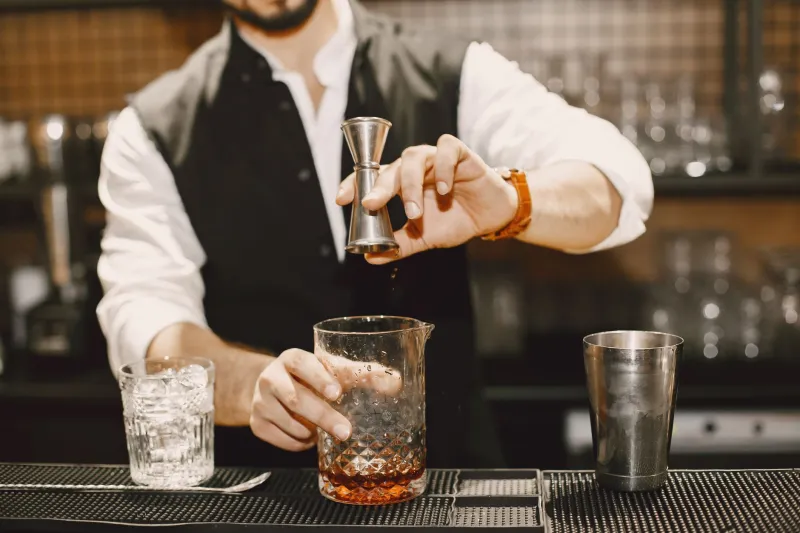
There is a particular theater to the free pour. The bottle tilts, the liquid arcs, the bartender's eyes drift just slightly upward—as if receiving instruction from somewhere above the room—and the drink is made. It looks confident. It looks experienced. What it does not always look like, if one has spent any time comparing the results against a measured alternative, is correct.
This is not a minor complaint dressed up in historical clothing. The relationship between measurement and the cocktail is as old as the form itself, and the casual abandonment of the jigger in many of America's most celebrated bars deserves more scrutiny than it typically receives.
What Jerry Thomas Understood
When Jerry Thomas published his Bar-Tender's Guide in 1862—the first cocktail book of consequence produced on American soil—he was already thinking in units. His recipes specified wineglasses, ponies, and dashes with a precision that reflected a professional's understanding of proportion. Thomas was not measuring because he lacked confidence. He was measuring because he understood that a cocktail is, at its structural core, a ratio, and that ratios only function when their components are controlled.
The bartenders who followed Thomas through the latter half of the nineteenth century refined this instinct. By the time Hugo Ensslin and his contemporaries were working in the years just before Prohibition, the jigger had become as standard a piece of bar equipment as the mixing glass. The measurement was not theater. It was engineering.
Prohibition disrupted much of this culture, and the decades that followed produced their own deformations—the sour mix era, the well-vodka era, the era in which the word 'cocktail' was applied to things that bore no meaningful relationship to the tradition. But when the craft revival began gathering momentum in the late 1990s and accelerated through the 2000s, the jigger returned with it. Bartenders like Dale DeGroff and Sasha Petraske were explicit about measurement as a form of respect—for the drink, for the guest, and for the history behind the glass.
When Confidence Became a Performance
Something shifted, and it is worth trying to identify precisely when and why. As the craft movement matured and its vocabulary became more widely shared, a secondary hierarchy began to form within it. The jigger, which had been a symbol of seriousness, began to read in certain quarters as a symbol of inexperience—as if a bartender who needed to measure had not yet fully internalized the ratios.
This is, to put it plainly, a confusion of two different skills. The ability to estimate volume by eye is a motor skill, trainable through repetition and useful in high-volume environments where speed has genuine value. It is not, however, the same skill as understanding why a particular ratio works, or how a quarter-ounce variation in citrus changes the balance of a drink. Conflating these two things—and then elevating the former as the more sophisticated capability—is a category error with real consequences for what ends up in the glass.
The free pour became, in certain establishments, a status marker. Younger bartenders absorbed the implicit message: measuring is for the uncertain. The jigger disappeared from the rail not because the drinks were better without it, but because its absence signaled something about the person making the drink.
The Reproducibility Problem
Here is where the argument becomes most difficult to dismiss. A cocktail program at a serious bar is, by definition, a repeatable system. A guest who orders a Daiquiri on a Tuesday and returns for the same drink on a Saturday is not ordering a new creative work—they are ordering the same drink twice. If the two drinks differ meaningfully in their proportions, then one of them is wrong, and the program has failed in a basic professional obligation.
Free pouring, even by experienced hands, introduces variance. Studies in hospitality management have documented this consistently: free pours tend to run heavy, they vary from pour to pour, and they vary between bartenders. In a well-run bar with a single skilled practitioner, the errors may be small. In a bar with multiple staff, rotating shifts, and the ordinary pressures of a busy service, those errors compound.
The irony is acute. The same bartenders who invest enormous care in sourcing obscure amari, in house-made syrups, in precise dilution through specific ice formats, will then free-pour the base spirit into a mixing glass and introduce a variable that renders all that upstream precision somewhat academic.
What the Jigger Actually Represents
The deeper argument for measurement is not really about milliliters. It is about epistemology—about how a bartender knows what they know. A bartender who measures, adjusts, and measures again is building a body of knowledge that can be transmitted, refined, and corrected. A bartender who free-pours is accumulating intuition that is real but largely private, difficult to teach, and impossible to audit.
The nineteenth-century bar professionals who made the cocktail into an art form were not romantics about this. They wrote things down. They quantified. They understood that craft without reproducibility is closer to luck than to skill, however impressive it may appear in the moment.
None of this argues against the development of intuition, or against the kind of improvisational intelligence that distinguishes a great bartender from a technically correct one. But intuition built on a foundation of measured practice is a different and more reliable thing than intuition that has simply bypassed the measurement stage entirely.
The jigger does not constrain the artist. It gives the artist something to push against—and, when necessary, something to return to. Its demotion from the rail was not a sign of the craft's maturity. It may, on reflection, have been a sign of something closer to the opposite.