One Glass, One City: The Sazerac and the Soul of American Drinking
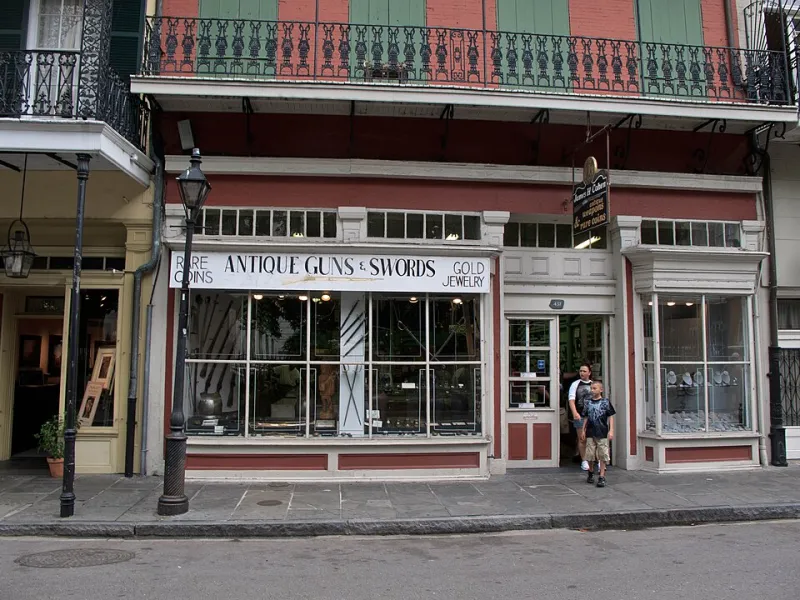
Photo: Gary J. Wood, CC BY-SA 2.0, via Wikimedia Commons
There is a particular kind of authority that comes with age. The Sazerac does not announce itself loudly. It arrives in a chilled Old Fashioned glass — no ice, no garnish beyond a lemon peel expressed and discarded, no ornamentation of any kind — and it simply waits. It has been waiting, in one form or another, since the 1830s. Few drinks in the American repertoire have earned that patience.
To trace the Sazerac is to trace something larger than a recipe. It is to follow the arc of an entire civilization's relationship with the glass in its hand.
The Pharmacy at the Corner of Everything
The story most often told begins with Antoine Amédée Peychaud, a Creole apothecary who emigrated from Saint-Domingue and opened a pharmacy on Royal Street in New Orleans sometime around 1838. Peychaud compounded his own bitters — a practice common among pharmacists of the era, who understood aromatic botanicals as medicine — and he mixed them with Sazerac-de-Forge et Fils cognac, a French brandy popular in the city's French Creole society. The result was served in a coquetier, the French word for egg cup, which some etymologists have proposed as the origin of the word "cocktail" itself. That particular claim remains contested, but the drink does not.
What Peychaud was making was, by the standards of the time, a simple cocktail in the original sense: spirit, sugar, water, and bitters. The genius was in the proportions and the specificity of ingredients. The Peychaud's bitters he formulated — lighter, more anise-forward than the Angostura style that would later dominate — gave the drink a character that was unmistakably local. New Orleans did not merely adopt a cocktail culture; it invented one with a distinct regional accent.
Rye Takes the Throne
The drink's first great transformation came not from any bartender's ambition but from a natural catastrophe: the phylloxera epidemic that devastated European vineyards in the second half of the nineteenth century. By the 1870s and 1880s, quality French cognac had become scarce and expensive. New Orleans bartenders, pragmatic as they were inventive, turned to American rye whiskey as a substitute. The substitution proved to be an improvement.
Rye brought a drier, spicier backbone that suited the Peychaud's bitters far better than the softer cognac had. It also made the drink unmistakably American in a way it had not quite been before. When Thomas H. Handy, who had taken over the Sazerac Coffee House on Exchange Alley, began popularizing the rye version in the 1880s and 1890s, he was not simply adapting to scarcity. He was, perhaps without realizing it, nationalizing a local institution.
The other crucial addition came around the same period: a rinse of absinthe. New Orleans had a thriving absinthe culture — the Old Absinthe House on Bourbon Street was already a fixture — and the practice of coating the glass with a small measure of the anise spirit before pouring the cocktail added a layer of aromatic complexity that transformed the drinking experience entirely. The absinthe does not flavor the drink so much as it perfumes it. You smell it before you taste it. That distinction matters enormously.
Survival Through Prohibition
When national Prohibition arrived in January 1920, it dealt a blow to American cocktail culture from which certain traditions never recovered. The Sazerac, however, was not among the casualties — at least not in New Orleans, where the enforcement of the Volstead Act was, to phrase it charitably, inconsistent. The city's French and Spanish colonial heritage, its Catholic culture, and its deep economic entanglement with the hospitality trade made it constitutionally resistant to the reformist impulse that drove Prohibition nationally.
Bars did not so much close as reclassify themselves. The Sazerac survived in the city's institutional memory, passed down through the hands of bartenders who kept working, kept mixing, kept serving. When repeal came in 1933, New Orleans did not have to rediscover the drink. It simply resumed.
Absinthe presented a more complicated problem. The spirit had been banned federally in 1912, eight years before Prohibition, on the basis of largely fabricated concerns about the alleged psychoactive properties of thujone. Bartenders substituted Herbsaint, a locally produced anise liqueur developed in New Orleans in 1934 specifically as an absinthe alternative. The substitution held for nearly a century, until the federal ban on properly made absinthe was effectively lifted in 2007. Today, most serious Sazerac recipes permit either, though partisans on both sides argue the point with considerable feeling.
What the Glass Actually Contains
The modern Sazerac — as codified by the Sazerac Company, which owns the Sazerac rye whiskey brand and the Peychaud's bitters formula, and as recognized by the Louisiana state legislature, which in 2008 designated it the Official Cocktail of New Orleans — consists of rye whiskey, Peychaud's bitters, a small amount of simple syrup or sugar, and an absinthe rinse, served in a chilled, uniced glass with a lemon twist expressed over the surface.
The absence of ice is not an oversight. It is a philosophy. The drink is meant to be consumed at a temperature that allows the rye and bitters to speak without the dilution and chill that ice would impose. It is a direct, unmediated experience — the kind of drinking that demands attention.
Why It Still Matters
Cocktail revivals come and go. The last two decades have seen the resurrection of dozens of pre-Prohibition recipes, some genuinely significant and others merely obscure. The Sazerac does not belong to that category of rediscovered curiosities. It never left.
What distinguishes the Sazerac from most other historically significant cocktails is the degree to which it remains embedded in a living culture. New Orleans bartenders do not make Sazeracs because cocktail enthusiasts have requested them; they make them because the city has never stopped ordering them. The drink is a continuous tradition rather than a reconstructed one, and that continuity gives it a kind of authenticity that no amount of archival research can manufacture.
It also tells a story that is worth hearing: that American drinking culture, at its most sophisticated, is regional before it is national. The Sazerac could only have come from New Orleans — from its French and Creole heritage, its port-city access to European spirits, its pharmacological traditions, its particular relationship with pleasure and resilience. To drink one is to participate, however briefly, in that inheritance.
The revolution the Sazerac started was not a loud one. It did not arrive with manifestos or movements. It arrived, as all genuine revolutions do, one glass at a time.