What the Ice Tells You: Recovering the Sensory Intelligence of the American Bar
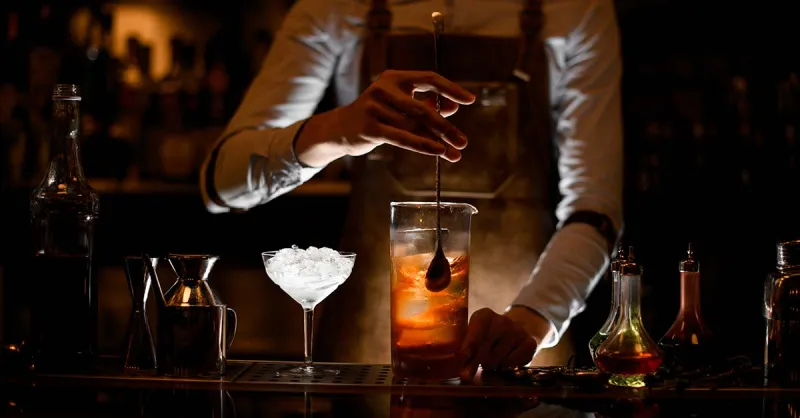
Photo: bartender stirring cocktail with ice in dimly lit bar close up, via blockice.com
There is a moment in the making of a proper drink—somewhere between the last stir and the moment the glass meets the bar—when everything goes quiet. Not the quiet of an empty room, but the composed, weighted silence of something finished. The ice has done its work. The dilution has found its level. The drink is ready. For a certain kind of bartender, that silence is not incidental. It is the point.
This may sound like the sort of romantic overstatement that cocktail writing is occasionally guilty of producing. But spend enough time with the historical record of American bartending—the manuals, the memoirs, the trade press going back to the middle of the nineteenth century—and you begin to notice how consistently the best practitioners of this craft described their work in sensory terms that had nothing to do with measurement. They listened. They felt. They paid attention to things that no recipe could specify.
The question worth asking now, as a serious generation of American bartenders works to reconstruct what was lost across a century of Prohibition, standardization, and the relentless pressures of high-volume service, is whether that attentiveness can be recovered. And whether, in recovering it, we might understand something about the craft that the recipe book alone cannot teach.
The Acoustic Life of the Bar
Jerry Thomas, whose 1862 Bar-Tender's Guide remains the founding document of the American cocktail tradition, was not a man given to sentimentality. He was a showman and a professional, and his instructions tended toward the practical. Yet even Thomas understood that the sounds of the bar were information. The crack of a fresh block of ice being worked. The particular rhythm of a shaker in motion. The soft percussion of a muddler finding the bottom of a glass. These were not incidental sounds. They were the acoustic signature of craft being practiced correctly.
By the early twentieth century, as Jerry Thomas's successors refined and codified the American bar, this sensory intelligence had become something close to instinct among the best practitioners. The bartenders of that era—men like William Schmidt and Hugo Ensslin, working in the great hotel bars of New York—understood that the sound of carbonation settling into a finished highball, or the way a well-chilled coupe rang faintly when set on marble, were signals worth attending to. The drink communicated, if you were listening.
Prohibition broke that chain of transmission with a thoroughness that is still difficult to fully appreciate. The men and women who carried the genuine knowledge of pre-Volstead bartending either retired, emigrated, or found themselves working in conditions—the speakeasy, the roadhouse, the blind pig—where sensory attentiveness was a luxury that circumstance rarely permitted. What returned after Repeal in 1933 was a simulacrum: the physical apparatus of the bar, without the accumulated intelligence that had once inhabited it.
Volume, Consistency, and the Muting of the Craft
The postwar American bar did not, for the most part, value silence. It valued speed. It valued consistency. It valued the kind of reliable, repeatable output that could satisfy a hundred customers in an evening without variation or incident. These are not contemptible virtues. But they are the virtues of a factory, not of a craft workshop, and their dominance over the second half of the twentieth century effectively suppressed the sensory dimension of bartending in ways that went largely unremarked.
The jigger, for all its indispensable utility, is partly responsible for this. The free-pour tradition that preceded it—practiced with genuine skill by experienced bartenders who had calibrated their hands over years of repetition—was itself a form of sensory knowledge. The feel of a spirit moving through the hand, the sound of it hitting ice at a particular rate: these were not imprecise guesses. They were refined perceptions. Standardized measurement solved a real problem of consistency, but it also, quietly, taught a generation of bartenders that the body's intelligence was not to be trusted.
The high-volume cocktail bar that emerged in American cities through the 1980s and 1990s completed the process. In an environment where a bartender might produce four hundred drinks on a Saturday night, there was simply no bandwidth for the kind of attentiveness that Thomas or Schmidt would have recognized as fundamental to the work. The drink became a product. The bar became a production line. And the silence before the first sip became, for most practical purposes, inaudible.
Listening Again
What is happening now in the better bars of cities like New York, Chicago, San Francisco, and New Orleans is not, at its core, about obscure ingredients or elaborate technique, though both are present in abundance. It is about attention. A new generation of American bartenders has arrived at the understanding—sometimes through deliberate historical study, sometimes through the more intuitive path of simply paying close attention to what works—that the sensory experience of making a drink is not decorative. It is functional.
The sound of ice in a mixing glass tells an experienced bartender something about dilution rate and temperature that no thermometer captures in real time. The resistance of a bar spoon moving through a stirred drink communicates viscosity and integration in ways that a timer cannot. The brief, particular silence after carbonation settles into a finished sparkling cocktail is not a pause in the work. It is the work announcing its completion.
This is not mysticism. It is craft knowledge of the kind that every skilled manual trade has always possessed, and that formal training systems have always struggled to transmit. The best bartending programs in the country are beginning to grapple with this, moving beyond the recipe-and-technique curriculum that has dominated professional education for decades toward something harder to quantify but arguably more important: the cultivation of sensory intelligence.
What the Glass Already Knows
There is a passage in the writings of the great nineteenth-century British drinks writer William Terrington—not widely read today, but worth the effort—in which he describes the ideal barman as someone who has learned to let the drink speak before the customer does. The formulation is elegant, and it points toward something that the best American bartenders of every era have understood instinctively: that a well-made drink has a kind of completeness to it that precedes consumption, and that the practitioner who cannot perceive that completeness is, in some essential sense, not yet finished learning.
Recovering that perception, after decades in which the American bar largely abandoned it in favor of speed and standardization, is neither simple nor quick. It requires the kind of deliberate, sustained practice that volume-oriented service environments rarely permit. It requires mentors willing to transmit knowledge that does not reduce to written instruction. And it requires, above all, a willingness to be quiet long enough to hear what the ice, the carbonation, and the weighted silence of a finished drink are already saying.
The best bars in America are learning to listen again. The rest of the craft would do well to follow.