When the Menu Became the Message: The Rise of the Cocktail List as a Literary Form
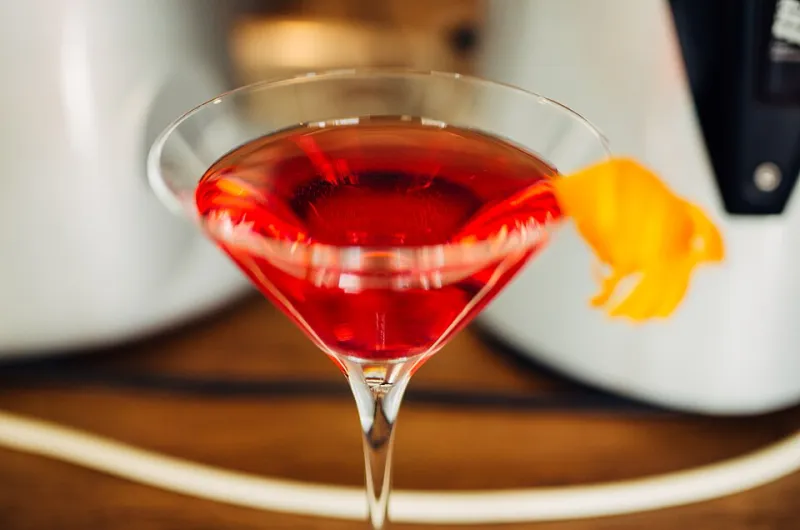
Photo: Shixart1985, CC BY 2.0, via Wikimedia Commons
There is a moment, familiar to anyone who frequents serious cocktail bars in this country, when the menu arrives and you realize it demands something of you. Not just a decision — a reading. The paper stock has been chosen with intention. The typeface carries a mood. The drink names are allusions, jokes, or elegies, and the descriptions below them read less like instructions to a bartender and more like the jacket copy of a novel you very much want to open. You are, in the fullest sense of the phrase, being told a story.
This was not always the case. For most of American drinking history, the menu — where it existed at all — was a practical document. A chalkboard. A folded card. A list of names beside a column of prices. The communication it performed was transactional: here is what we have, here is what it costs, make your selection. The idea that a drinks list might constitute a form of authorship would have struck the average nineteenth-century saloon keeper as either pretentious or absurd.
So how did we arrive at the present moment, in which the menu at a serious cocktail bar in New York, Chicago, or San Francisco is frequently a designed object of genuine sophistication — one that functions simultaneously as brand statement, editorial document, and curatorial gesture?
From Chalkboard to Manifesto
The shift began, as so many things in American cocktail culture did, in the early years of this century, when a generation of bartenders trained themselves in the history and craft of their trade with a seriousness that had not been seen since before Prohibition. These practitioners — deeply literate about ingredients, techniques, and the long arc of mixological tradition — found themselves with a great deal to say. The cocktail itself was one vehicle for that expression. The menu became another.
Bars like Milk & Honey in Manhattan, which opened in 1999, and Violet Hour in Chicago, which followed in 2007, were among the early establishments to treat the menu as something more than a price sheet. The drinks they served were researched and considered; it followed that the documents describing those drinks should be, too. Descriptions grew longer. Names grew more allusive. The physical object of the menu began to reflect the aesthetic sensibility of the bar itself.
What emerged, over the course of roughly two decades, was a new genre of hospitality writing — one governed by its own conventions, ambitions, and pitfalls.
The Grammar of the Modern Cocktail Menu
To read a well-constructed cocktail menu today is to encounter a set of literary choices as deliberate as those made by any editor assembling a collection. The naming of a drink is among the most consequential of these decisions. A name can situate a cocktail historically, as when a bar reaches back to a pre-Prohibition original and presents it under its original designation — a signal of scholarship and respect for the tradition. It can be whimsical, inviting the drinker into a playful register. It can be austere, listing only the primary ingredients in a manner that communicates confidence and restraint.
The descriptive copy that accompanies a drink performs a different function. At its best, it is genuinely informative: it tells the drinker something true and useful about what they are about to consume — the origin of an unusual spirit, the technique behind a particular texture, the seasonal provenance of a featured ingredient. At its worst, it drifts into a kind of atmospheric fog, all evocative adjectives and no actual content, the prose equivalent of a candle that smells like "wanderlust."
The physical design of the menu — its dimensions, materials, typography, and layout — constitutes a third layer of communication. A menu printed on heavy uncoated stock and bound with a leather cord tells you something different about a bar's self-conception than one presented on a single sheet of matte paper. Neither is inherently superior; both are arguments.
The Risk of Overthinking the Glass
It would be dishonest not to acknowledge the ways in which this literary ambition can curdle. The cocktail menu, like any vehicle for self-expression, is susceptible to the particular vanities of its moment. There is a strain of contemporary menu writing that mistakes obscurity for sophistication — that names drinks after figures the drinker cannot be expected to recognize and offers descriptions so dense with technical vocabulary that they communicate primarily the author's expertise rather than anything useful to the person holding the card.
There is also the question of sincerity. A menu that presents itself as a meditation on place and season is making an implicit promise about what is in the glass. When the drinks themselves fail to honor that promise — when the ingredients are not quite as local or as seasonal as the copy suggests, when the philosophy stated on the page is not legible in the flavor — the literary ambition of the menu becomes a liability rather than an asset. The document has overpromised, and the drinker feels, quite rightly, that they have been subjected to marketing rather than hospitality.
What the Best Menus Actually Do
The cocktail lists that earn genuine admiration tend to share a quality that is difficult to name precisely but easy to recognize: they are honest. They tell the drinker what the bar actually believes, not what the bar thinks the drinker wants to hear. They make choices — about length, about tone, about the degree of explanation offered — that reflect a coherent point of view rather than an attempt to appeal to every possible sensibility simultaneously.
The best menus are also, in an important sense, generous. They assume that the drinker is curious and capable of engagement, without demanding that they arrive already fluent in the bar's particular vocabulary. They offer enough context to be illuminating without becoming didactic. They leave room for the drink itself to do its work.
This is, when you consider it, a description of good writing in any form. The cocktail menu, at its most accomplished, is not so different from a well-edited magazine or a thoughtfully organized anthology: it presents a selection of things worth encountering, in an order and context that help the reader understand why they are worth encountering, and then it steps out of the way.
A Document That Earns Its Ambitions
The transformation of the American cocktail menu from a utilitarian list into a considered literary object is, in its way, a measure of how seriously this country has come to take the art of the drink. It reflects the same impulse that has driven the revival of pre-Prohibition recipes, the renewed attention to provenance in spirits production, and the broader rehabilitation of the bartender as a skilled professional rather than a mere dispenser of alcohol.
That the menu should bear the weight of this ambition is, perhaps, inevitable. The cocktail has always been a communicative act — a way of saying something about taste, knowledge, and care. The menu is simply the opening sentence of that conversation. When it is written well, the rest of the evening tends to follow.