Old Methods, New Arguments: The Craft Distillers Using History to Challenge Industrial Spirits
Authenticity is among the most abused words in the contemporary spirits lexicon. It appears on labels, in tasting room scripts, and across the marketing materials of producers whose relationship with historical practice ranges from the genuinely rigorous to the purely cosmetic. A wax-dipped bottle and a sepia-toned label do not constitute a philosophy. But somewhere within the current wave of small-batch American distilling, beneath the branding and the origin stories, there exists a more serious argument—one that uses historical production methods not as decoration but as evidence.
The producers making that argument are worth distinguishing from the broader craft movement, because their intentions are different. They are not primarily interested in nostalgia. They are interested in flavor, and they have concluded that the most persuasive way to make their case is to demonstrate, in the glass, what industrial efficiency has cost the American spirit.
The Evidence in the Fermentation Room
The argument begins, for many of these producers, not at the still but at the fermenter. Open fermentation—the practice of conducting fermentation in unsealed wooden or stone vessels, exposed to the ambient environment of the distillery—was standard practice in American whiskey production well into the twentieth century. It was displaced, gradually and then decisively, by closed stainless-steel fermenters that offered superior temperature control, reduced contamination risk, and the kind of consistency that large-scale production demands.
The case against open fermentation, on industrial grounds, is entirely sound. The case for it, on flavor grounds, is made every time a whiskey produced in a traditional cypress or Douglas fir fermenter is placed beside one produced in sealed steel. The open fermenter introduces variables—ambient yeast populations, temperature fluctuations, microbial complexity—that the closed system eliminates. Whether those variables are desirable depends on what one believes a whiskey should taste like. The craft producers who have returned to open fermentation believe, and are prepared to argue at length, that the complexity those variables introduce is not a defect. It is the flavor.
Some of the most compelling work in this area is being done at distilleries that have gone further still, sourcing heritage grain varieties—Bloody Butcher corn, Turkey Red wheat, heirloom rye strains—that were abandoned by industrial agriculture because they yielded poorly or processed inconveniently. The flavor differences between a whiskey made from a modern commodity hybrid and one made from an open-pollinated heritage variety are not subtle to a trained palate. They are the difference between a functional ingredient and a specific one, between a grain that was grown to be efficient and a grain that was grown, over generations, to taste like something.
The Still as Argument
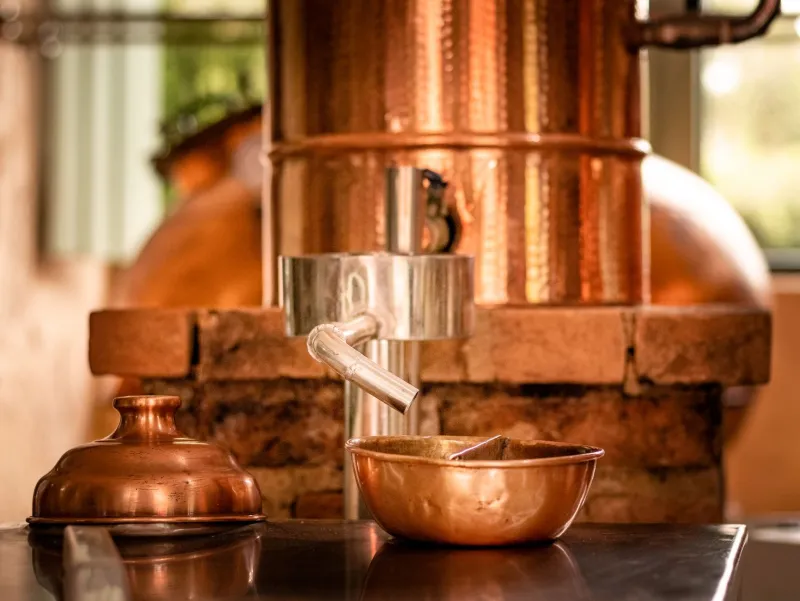
The choice of still is perhaps the most visible dimension of this conversation, and the one most susceptible to cosmetic deployment. The pot still—copper, direct-fired, small in capacity—is the instrument of artisanal production in the popular imagination, and it appears in distillery photography and brand identity work with a frequency that has somewhat diluted its meaning. Not every producer who owns a handsome copper pot still is making an argument about flavor. Some are making an argument about aesthetics.
But the producers who are serious about the historical case use the still not as a prop but as a tool with specific consequences. The pot still retains congeners—flavor-active compounds that a continuous column still, operating at higher proof, strips from the distillate. The resulting spirit is heavier, more textured, and more demanding of time in the barrel. It is not, in the short term, more efficient. It is, in the considered judgment of its advocates, more flavorful—and more honest about what a distilled spirit, at its core, is supposed to be.
This is where the tension between authenticity as marketing and authenticity as principle becomes most visible. Both the serious producer and the brand-conscious imitator may own a pot still and describe their product as traditionally made. The distinction lies in whether the choices made in production—the grain, the fermentation, the cut points, the barrel entry proof—are made in service of a flavor argument or in service of a label claim. The former requires consistency of purpose across every decision in the distillery. The latter requires only a convincing photograph.
The Market's Verdict, and Its Limits
The commercial success of American craft spirits over the past two decades has created a paradox for the producers making the most rigorous historical arguments. Their methods, validated by growing consumer interest in provenance and process, have attracted investment and imitation at a scale that has, in some cases, begun to compromise the very practices that distinguished them. A craft distillery that expands its capacity must eventually confront the same pressures—consistency, volume, cost—that drove the industry toward industrial methods in the first place.
The most intellectually honest producers acknowledge this tension openly. The argument they are making is not that small is inherently better, or that age is inherently superior. It is that specific choices in production produce specific results in the glass, and that the American spirits industry, in its pursuit of efficiency and uniformity, made choices that are worth revisiting with fresh evidence. The heritage grain whiskey, the open-fermented rum, the pot-distilled American brandy—these are not museum pieces. They are propositions, submitted for tasting.
History, in this reading, is not a brand. It is a laboratory. The craft producers who understand this distinction are doing work that will matter to the American spirits tradition long after the wax seals and vintage typography have been forgotten. Their bottles are arguments. Whether the market is prepared to follow the argument wherever it leads remains, for the moment, an open question.