The Vanishing Ounce: What the Shrinking American Bar Pour Reveals About the State of the Drink
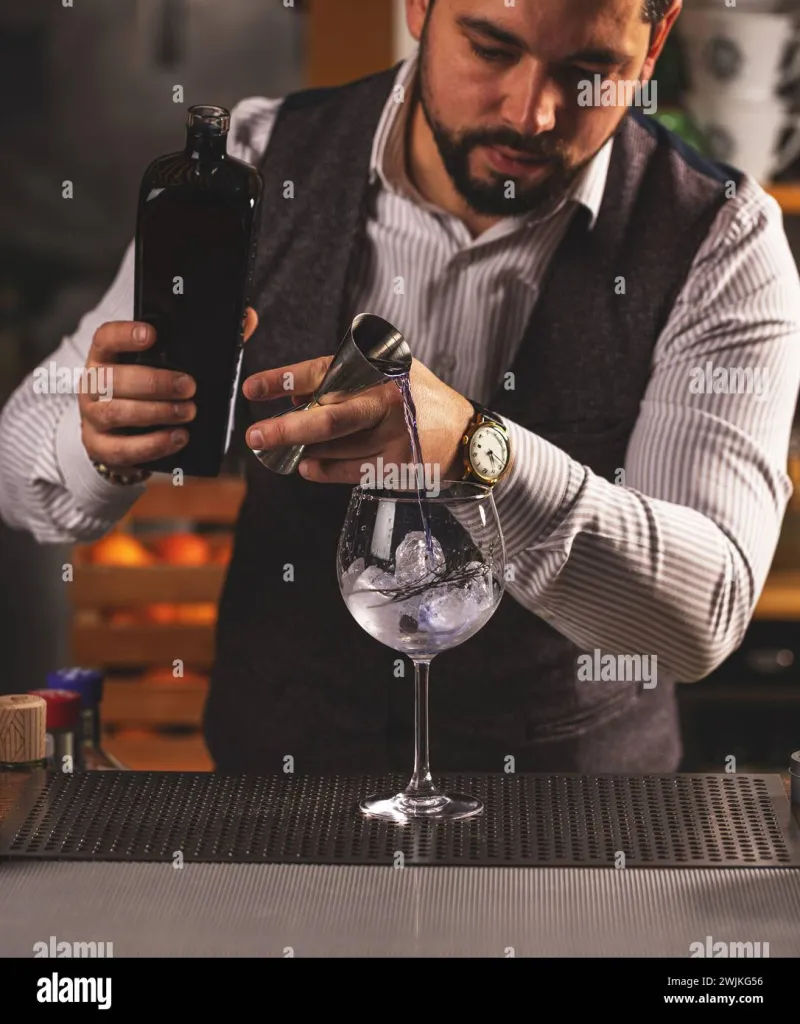
Photo: bartender measuring cocktail jigger whiskey pour bar counter, via c8.alamy.com
There is a particular kind of loss that announces itself only in retrospect. You do not notice it happening. You notice, one day, that something has changed—that the glass feels lighter, that the drink disappears faster, that the warmth you once associated with a well-made whiskey sour arrives, if at all, a beat or two later than it used to. The pour has gotten smaller. It has been getting smaller for years. And almost no one has said a word about it.
This is not a complaint dressed up as criticism. It is an invitation to examine something that the American bar industry has managed, with remarkable efficiency, to render invisible: the slow, systematic reduction of what a standard drink actually contains.
The Historical Measure and Its Discontents
The American bar has never operated from a single, codified standard. Unlike the United Kingdom, where the government has long regulated pub measures with statutory precision, the United States has historically left pour sizes to the discretion of individual establishments, state liquor boards, and, ultimately, market forces. What emerged from that relative freedom was something like a working consensus: through much of the twentieth century, a standard cocktail pour in a well-run American bar hovered between one and a half and two ounces of base spirit.
Jerry Thomas, whose 1862 Bar-Tender's Guide remains the foundational document of American cocktail culture, wrote recipes calibrated to the generous side of that range. The drinks he described were meant to be felt, not merely tasted. The same was true of the craft that followed him—through the gilded saloons of the 1880s, the desperate ingenuity of the Prohibition era's better speakeasies, and the mid-century hotel bars that kept classical technique alive while the rest of the country discovered the highball. The measure was, in a sense, a statement of hospitality.
What has happened since is harder to date precisely, which is part of why it has gone largely unremarked. There was no single moment of contraction. There was, instead, a long series of small adjustments—a quarter ounce here, an eighth of an ounce there—each one defensible on its own terms, each one contributing to a cumulative shift that has, by most reasonable estimates, reduced the average American cocktail pour by somewhere between fifteen and thirty percent over the past two decades.
The Economics of the Empty Glass
The explanation, when bar owners are pressed for one, is straightforward enough: cost. The price of premium spirits has risen sharply. Labor costs in major American cities have climbed. The elaborate garnishes, house-made syrups, and imported bitters that define the contemporary craft cocktail represent real overhead. Somewhere in the calculation, the spirit itself—the thing that was once the point—became a variable to be managed rather than a constant to be honored.
This is not without precedent. Economic pressure has always shaped what ends up in the glass. During both World Wars, American distillers were redirected toward industrial production, and the spirits that did reach bars were frequently stretched and diluted. The post-Prohibition years saw a domestic industry rebuilding from nothing, with quality uneven and quantities carefully controlled. Bars have always absorbed the shocks of the broader economy through the only mechanism available to them: the drink itself.
What distinguishes the current moment is the sophistication with which the reduction has been obscured. The craft cocktail movement, for all its genuine contributions to American drinking culture, has provided the perfect cover. When a drink arrives in a coupe glass, garnished with a dehydrated citrus wheel and a sprig of something foraged, the drinker's attention is directed everywhere but toward the question of how much spirit is actually present. Complexity, it turns out, is an excellent distraction from quantity.
What the Jigger Knows
The jigger—that small, hourglass-shaped measuring tool that became a symbol of craft bartending's return to precision in the early 2000s—is itself a study in ambiguity. A standard jigger typically measures one and a half ounces on one side and three-quarters of an ounce on the other. But jigger sizes vary. Pours vary. And the practice of free-pouring, which never fully disappeared from American bars even during the height of the craft revival, introduces its own inconsistencies.
What has changed is not the tool but the intention behind it. The jigger was once deployed in service of consistency and generosity—a guarantee that the customer received what the recipe promised. Increasingly, it functions as an instrument of portion control, ensuring that the bar's cost-per-drink calculations remain intact regardless of what the customer might reasonably expect.
This distinction matters. A bar that measures carefully in order to make a better drink is practicing craft. A bar that measures carefully in order to protect margin while presenting the appearance of craft is practicing something rather different, and the American drinking public, whatever its other sophistications, has been slow to recognize the difference.
The Consumer's Complicity
It would be unfair, however, to place the entire burden of this shift on the industry. American drinkers have, in important ways, invited it. The premium placed on narrative—on provenance, on ingredient sourcing, on the bartender's personal philosophy—has created a market in which the story surrounding the drink can be priced independently of the drink itself. A fifteen-dollar cocktail that contains one ounce of spirit is not, in the current climate, obviously a worse value proposition than a twelve-dollar cocktail that contains two ounces, provided the former comes with a sufficiently compelling account of how the bitters were made.
This is not entirely new, either. The American bar has always traded in atmosphere and theater as much as in alcohol. What is new is the degree to which the theater has become a substitute for, rather than an accompaniment to, the substance.
There is also the question of how Americans now relate to alcohol itself. A drinking culture increasingly attentive to wellness, to moderation, to the cumulative effects of regular consumption, is perhaps less troubled by smaller pours than a previous generation would have been. The shrinking drink may, in this reading, reflect not exploitation but accommodation—a bar industry responding to a clientele that genuinely wants less, or believes it does.
What Is Owed Across the Bar
None of this resolves the fundamental question of honesty. Whatever the economic pressures, whatever the shifts in consumer preference, a bar that charges for a standard pour and delivers something measurably less has engaged in a transaction that deserves scrutiny. The hospitality industry's social contract has always rested on a reasonable correspondence between what is offered and what is received.
The measure, in this sense, is not merely a unit of volume. It is an expression of respect—for the spirit, for the craft, and for the person sitting on the other side of the bar. When it becomes negotiable without acknowledgment, something is lost that cannot be recovered by a more elaborate garnish or a more evocative menu description.
Jerry Thomas understood this. The great bartenders who followed him understood it. The question now is whether the American bar, in its current form, is prepared to reckon with what it has quietly surrendered—and whether the drinkers it serves will eventually notice the absence well enough to ask for it back.