The Trouble with Tasting Notes: Why the Language of Spirits Has Drifted From the Glass
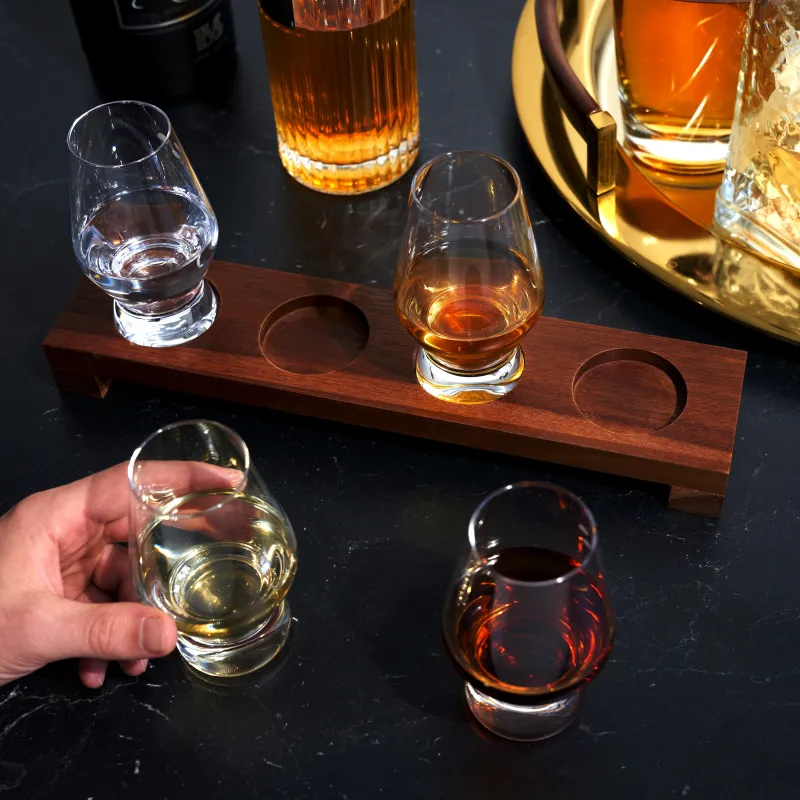
Photo: whiskey tasting flight spirits evaluation professional bar, via viski.com
Somewhere along the way, the tasting note became a performance. Open any whiskey publication, scroll through any spirits competition catalog, or read the back label of a sufficiently premium bottle, and you will encounter the same baroque architecture of flavor descriptors: dried stone fruit, toasted almond, a suggestion of old leather, a finish reminiscent of a library in autumn. These notes are written with confidence and read with reverence. They are also, in many cases, telling you almost nothing useful about the liquid they describe.
This is not an accusation of dishonesty. Most professional tasters are sincere in their assessments. The problem is structural, and it runs deeper than any individual evaluator's credibility.
How the Language Got So Elaborate
The formal vocabulary of spirits evaluation largely derives from wine criticism, which in turn owes a great deal to the work of Ann Noble, a flavor chemist at UC Davis who developed the Wine Aroma Wheel in 1984. Noble's wheel was a genuine scientific contribution — a tool for organizing the identifiable volatile compounds in wine into recognizable categories. It was designed to standardize communication among researchers and trained professionals.
What happened next was predictable: the wine trade adopted the wheel's vocabulary as a marketing language, and the spirits industry followed. Terms that had been developed to describe measurable chemical compounds were repurposed as evocative prose. "Ethyl hexanoate" became "green apple." "Isoamyl acetate" became "banana." The translation from chemistry to poetry is not inherently dishonest, but it opens a door through which a great deal of creative license walks.
By the time American whiskey entered its current period of cultural ascendancy — roughly the mid-2000s onward — the tasting note had evolved into something closer to lifestyle copy than sensory description. Bourbon releases began arriving with notes that referenced specific seasons, geographic landscapes, and nostalgic emotional states. The whiskey was no longer being described; it was being narrated.
The Psychology Working Against Your Palate
Here is what the research actually shows. In a now-famous 2001 experiment, Frédéric Brochet at the University of Bordeaux presented a group of wine students with two glasses — one containing a white wine and one containing the same white wine dyed red with odorless food coloring. The students, trained in formal tasting, described the dyed wine using red wine vocabulary: jam, prune, chocolate, tobacco. The color had overridden their palates entirely.
This is not a failure of intelligence or training. It is a feature of how human perception works. We are extraordinarily susceptible to visual and contextual cues when evaluating flavor. We taste what we expect to taste, and our expectations are shaped by everything surrounding the glass: the bottle's design, the price point, the reputation of the distillery, the notes on the shelf card, and — crucially — what the person next to us claims to detect.
Professional evaluators are not immune to these effects. In some respects, they are more vulnerable. Extensive training in a particular tasting framework can entrench a set of expected descriptors that the evaluator then finds, reliably, in almost every glass. The vocabulary becomes self-fulfilling. A judge who has been trained to find vanilla and caramel in bourbon will find vanilla and caramel in bourbon, whether or not those compounds are present in concentrations that a naive taster would detect.
The Competition Problem
Spirits competitions have proliferated enormously over the past two decades. Gold medals, double-gold medals, and category awards now appear on bottle necks and shelf talkers throughout American liquor stores, and consumers reasonably treat them as useful guidance. The trouble is that competition judging, conducted under time pressure with dozens or hundreds of entries, tends to reward the legible over the interesting.
A whiskey that presents its characteristics boldly and conventionally — big vanilla, obvious oak, a clean, warm finish — will score well across a diverse panel because its qualities are easy to agree on. A more idiosyncratic spirit, one that requires time and attention to reveal itself, may score inconsistently because its virtues are harder to articulate quickly and harder to achieve consensus around. Competitions, by their nature, favor the persuasive over the subtle.
This is not a conspiracy. It is a structural outcome of asking multiple people to reach agreement about something as subjective as flavor under competitive conditions. But the result is a market signal that pushes distillers toward a legible, crowd-pleasing profile and away from genuine distinctiveness.
Terroir and Its Discontents
Perhaps no concept in contemporary spirits marketing has generated more elaborate language with less empirical support than terroir — the idea that the specific geography, soil, and climate where a grain was grown impart detectable and meaningful characteristics to the final spirit. Borrowed from wine, where the concept has genuine scientific support in certain contexts, terroir has been applied to bourbon, rye, and single malt Scotch with increasing enthusiasm and decreasing rigor.
The distillation process is extraordinarily transformative. The chemical compounds present in a grain's growing environment undergo radical change through malting, mashing, fermentation, distillation, and years of barrel aging. To claim that a taster can reliably detect the limestone-filtered water of a specific Kentucky county, or the maritime air of a coastal Scottish island, in a finished spirit is to make a claim that has proven remarkably resistant to controlled verification.
This is not to say that origin is meaningless. Water chemistry, grain variety, yeast strains, and distillation equipment all matter. But the specific romantic geography invoked in premium terroir marketing — the fog rolling off a particular highland loch, the red clay of a Tennessee valley — is frequently more metaphor than mechanism.
What to Do With Your Own Glass
None of this means that tasting notes are worthless or that professional evaluation has nothing to offer. The point is more modest: that the elaborate language of spirits expertise has, in some quarters, become a barrier to honest personal engagement with what is in the glass.
The most useful thing any drinker can do is to taste with deliberate attention and then trust what they find — even when, especially when, it contradicts the received wisdom on the label or the score in the catalog. If a highly decorated bourbon strikes you as unremarkable, that response is data. If a modestly priced rye delivers consistent pleasure, that too is data, and it is data that matters more to your drinking life than any panel's consensus.
The great historical bartenders — the men and women who built American cocktail culture before it had a critical apparatus surrounding it — made their choices based on what worked in the glass and what their customers enjoyed. They did not wait for a tasting note to tell them what they were tasting. Neither should you.